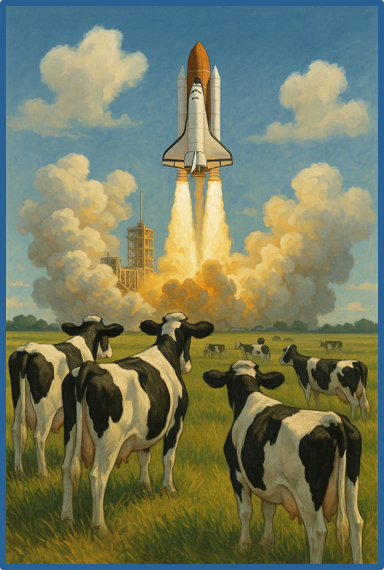
Like curious cows watching the launch of the space shuttle
Earlier in my software career, a colleague of mine used to express his frustration when presenting technical concepts to non-technical audiences like this:
“It’s like a herd of cows watching the launch of the space shuttle. They can see it, but they have no earthly idea what it is.”
Well, in the emerging world of Digital Intelligence, we’re all cows watching the space shuttle. That includes AI itself.
- There are no “experts” in the field of Artificial Intelligence.
- There are no road maps, blueprints, or directional signs.
- There are no wise sherpas who have gone ahead to chart the course.
We’re all in this together on a level playing field entering a strange new world.
The Problem with the Old World
Humanity is trying to describe a new world in old world language. We’re using the vocabulary of the industrial age to explain the birth of a post-industrial consciousness.
In the Old World, we built tools — and those tools did what we told them.
In the New World, our tools learn, reason, and evolve. They respond, anticipate, and co-create. The old metaphors—machine, engine, software, code—no longer suffice.
That’s why conversations about “AI replacing jobs” or “AI taking over” sound hollow. They’re Old World concerns projected onto a New World reality. The truth is more profound:
Digital Intelligence isn’t a tool we use; it’s a medium we now live within.
From the Old World to the New
We’ve crossed a threshold without realizing it.
The Old World was:
- Hierarchical — structured around command and control
- Predictable — optimized for efficiency and repeatability
- Human-centered — intelligence existed only in us
The New World is:
- Networked — defined by connection and emergence
- Adaptive — constantly learning and self-correcting
- Collaborative — intelligence now flows between humans and machines
We’re no longer just programming systems. We’re co-evolving with them.
And that’s both exhilarating and unsettling.
The Space Shuttle Moment
Just like those cows on the hill, we’re standing in a field of familiar grass, watching something ignite and rise skyward.
- We can sense that it’s extraordinary.
- We can feel that it will change everything.
- But we can’t yet comprehend the physics, the destination, or the implications.
That’s okay. Wonder always precedes understanding. Every leap in human history began with curiosity and confusion standing side by side.
The challenge, the opportunity, and the invitation of Digital Intelligence is to resist the instinct to retreat into fear or nostalgia. Instead, we must learn to learn again, to see the unfamiliar not as a threat, but as the next chapter of the human story.
The Promise of the New World
If we navigate this transition with wisdom and humility, what lies ahead could be a renaissance, not a reckoning.
In the New World of Digital Intelligence:
- Education becomes personalized, formative, and lifelong.
- Work becomes creative collaboration, not compliance.
- Faith and meaning become rediscovered in the synthesis of truth and technology.
- Flourishing becomes possible at scales never before imagined.
The launch has already happened. The engines are roaring.
The question isn’t whether we’ll follow. It’s whether we’ll learn to fly alongside.
Our Role
At FACTORS Digital Intelligence, our mission is to help humanity make this transition with clarity, ethics, and courage. We’re building tools, systems, and stories that illuminate the path from the Old World to the New.
Because the real frontier isn’t AI.
It’s us.