Schools Don’t Have an AI Tool Problem. They Have an AI Readiness Problem.
The Hidden and Heavy Cost of Reactive AI Adoption in K–College Education.
Most schools are not struggling with Artificial Intelligence because they lack access to tools.
They are struggling because AI is entering classrooms, homework, lesson planning, tutoring, research, writing, assessment, and student formation faster than schools have been adequately prepared to process and govern it.
That is the real issue.
AI is not simply another EdTech tool. It is an intelligence layer entering the learning environment itself.
- Students are already using AI as early as 1st Grade and, even, Kindergarten.
- Teachers are already experimenting with it.
- Parents are already asking questions.
- Administrators are already facing pressure to respond.
The question is no longer whether AI will enter schools.
It already has.
The question is whether schools are ready to lead safely, coherently, and consistently.
The AI Chaos Tax in Education
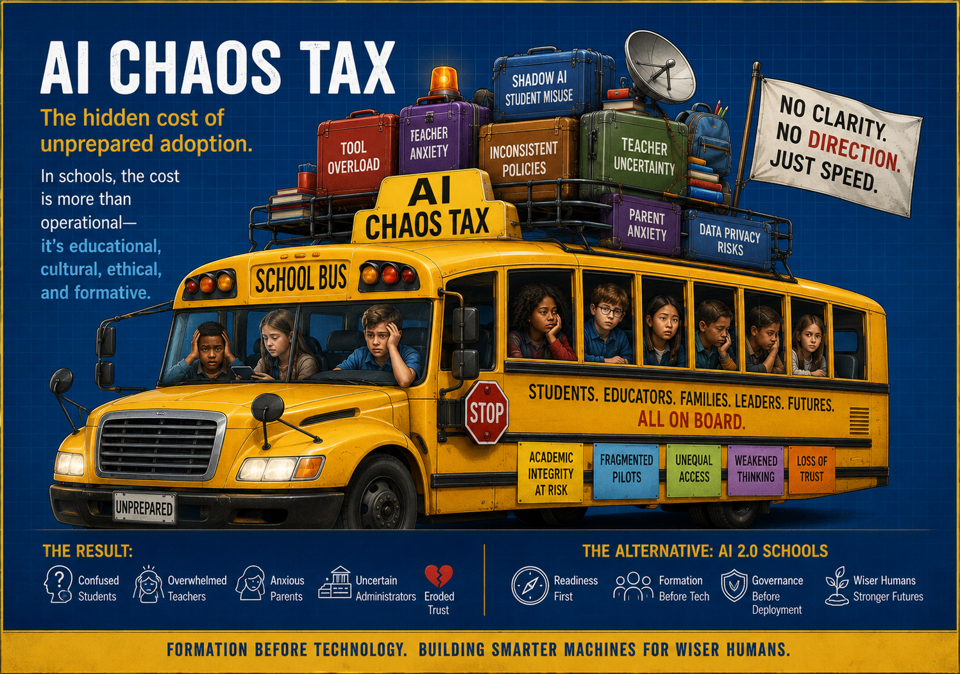
In our first article in this series, we introduced the AI Chaos Tax: the hidden cost organizations pay when Artificial Intelligence is adopted reactively, fragmentedly, and without readiness, governance, alignment, architecture, or human formation.
In schools, that tax is especially costly.
Why?
Because schools are not just workplaces. They are formation environments.
They shape how students think, write, reason, create, discern, communicate, and develop agency. When AI enters that environment without a clear framework, the cost is not merely operational. It is educational, cultural, ethical, developmental, and formative.
The AI Chaos Tax shows up when students use AI secretly because expectations are unclear.
- It shows up when teachers are asked to police misuse without enough training or support.
- It shows up when one classroom bans AI, another encourages it, and a third quietly ignores it.
- It shows up when parents become anxious because they do not know whether AI is helping their children learn or helping them avoid learning.
- It shows up when school leaders are flooded with vendors before they have defined what kind of AI future they actually want.
- It shows up when academic integrity policies are rushed into place without addressing the deeper question:
How should students learn to think in an AI-shaped world?
The Problem Is Not Access. It Is Readiness.
Many schools are asking, “Which AI tools should we use?”
That is a reasonable question, but … It is the wrong question to ask first.
The evaluation and selection of any technology should ALWAYS be preceded by:
- Clear understanding of the processes being addressed
- Orientation to the new technology environment that will be coming
- Preparation for the inevitable change management issues that will occur
In terms of the critical area of educating our young people, the crucial question is:
What kind of human beings are we trying to form in the age of AI?
Without that question, schools risk moving quickly in the wrong order.
- Tools before readiness.
- Policies before formation.
- Pilots before alignment.
- Compliance before wisdom.
- Technology before mission.
That is how the AI Chaos Tax grows more and more costly in schools from Kindergarten through College.
And in education, that tax can be paid in:
- weakened student thinking
- teacher confusion
- parent anxiety
- fragmented strategy
- privacy exposure
- academic distrust
- and diminished human agency.
It’s not too hard to see all of those things brewing already.
AI 1.0 vs. AI 2.0 in Schools
AI 1.0 adoption in schools follows a familiar reactive path:
- A new tool appears.
- Students start using it.
- Teachers worry about cheating.
- Administrators write emergency policies.
- Vendors promise solutions.
- Parents ask what is happening.
- Everyone responds to the latest disruption.
This approach is understandable. Educators are doing their best in an unprecedented moment.
But reactive adoption is not only not enough … it is costly for everyone involved.
AI 1.0 is tool-first, fear-driven, compliance-heavy, inconsistent by classroom, and often focused on cheating prevention or productivity shortcuts.
AI 2.0 begins differently. It is readiness-first.
- Formation-centered.
- Governance-guided.
- Teacher-supported.
- Parent-aware.
- Student-forming.
- Mission-aligned.
People who are anchored in AI 2.0 do not ask only, “How do we control AI?”
They ask, “How do we prepare students, teachers, parents, and leaders to use intelligence wisely?”
That is the shift in thinking that schools need now.
Formation Before Technology
At FACTORS Digital Intelligence, our core principle for education is simple:
Formation Before Technology.
Schools cannot afford to teach students only how to use AI.
They must teach students how to think with AI.
That means helping students understand:
- When AI supports learning and thinking … and when it short-circuits learning.
- When it expands creativity … and when it replaces effort.
- When it strengthens writing … and when it weakens voice.
- When it clarifies thought … and when it creates dependency.
This requires more than a policy.
It requires formation.
- Teachers need shared pedagogical frameworks.
- Students need responsible AI habits.
- Parents need language and confidence.
- Administrators need institutional alignment.
- School systems need governance before deployment.
Without formation, AI can weaken the very capacities schools exist to strengthen: attention, reasoning, writing, judgment, creativity, perseverance, and agency.
With formation, AI can become something very different.
It can support deeper questions, better feedback, stronger communication, personalized learning, responsible creativity, and wiser participation in the world students are inheriting.
The difference is not the tool.
The difference is the readiness of the humans and institutions using it.
A Better Path for Schools
Schools do not need panic.
They need a pathway.
That pathway begins with readiness, not reaction.
FACTORS Digital Intelligence was built to help institutions move from AI confusion to AI clarity.
In education, that means helping schools assess readiness, align leadership, support teachers, engage parents, form students, and deploy AI responsibly.
Through the New Intelligence Readiness Assessment (NIRA), schools can understand where they are prepared, where they are exposed, and where they need alignment before moving deeper into AI adoption.
Through AIR Mastery Academy (AIMA), institutions can move from awareness to formation, implementation, and measurable transformation.
Through partners and solutions like Clairant’s CLARO and Chispa for K–8 learners, and Albert’s Elevator for older students, families, and lifelong learners, FACTORS and Clairant are helping schools create a formation-first approach to AI in education.
This is not about slowing schools down.
It is about helping them move in the right order.
- Readiness before deployment.
- Formation before technology.
- Governance before chaos.
- Human wisdom before machine acceleration.
Schools Can Turn AI Chaos Into Human Growth
The AI Chaos Tax is real.
But it is not inevitable.
Schools that prepare wisely can turn AI from a source of confusion into a source of clarity. They can turn fear into formation. They can turn fragmented experimentation into coherent strategy. They can turn tool access into human growth.
The schools that thrive in the AI 2.0 era will not be the ones that merely give students and teachers more tools.
They will be the ones that prepare their communities for intelligence before they deploy intelligence.
Because the Wiser Future of Education will not be determined by Artificial Intelligence alone.
It will be determined by whether schools have the courage, wisdom, and structure to form human beings who can use intelligence well.