What Organizations Pay When Readiness Comes Too Late
Most organizations are not failing at AI because the technology is too weak.
They are failing because they are trying to force AI 2.0 capabilities through antiquated software implementation methods and ill-prepared AI 1.0 operating models.
That is the hidden problem beneath much of today’s AI activity. Leaders feel pressure to “do something with AI.”
- Departments launch pilots.
- Employees experiment with tools.
- Vendors promise transformation.
- Consultants bring frameworks.
- Boards ask for progress.
On the surface, it looks like momentum.
Underneath, many organizations are quietly accumulating a new kind of cost.
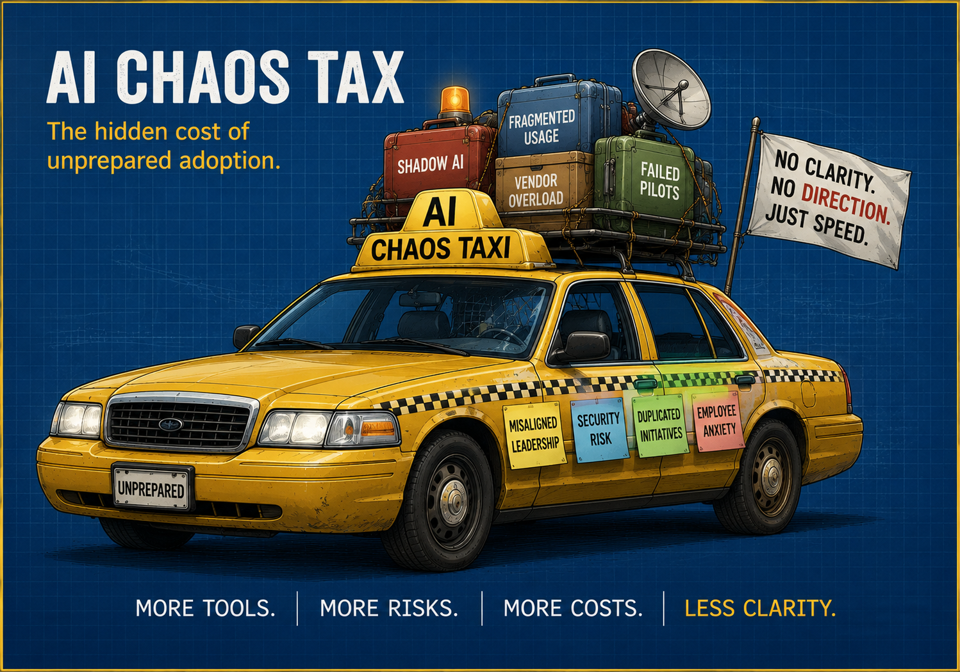
We call it the AI Chaos Tax.
What Is the AI Chaos Tax?
The AI Chaos Tax is the hidden cost organizations pay when they adopt Artificial Intelligence reactively, fragmentedly, and without proper readiness, governance, alignment, architecture, and human formation.
It shows up in many forms:
Fragmented AI usage. Shadow AI. Duplicated initiatives. Confused employees. Misaligned leaders. Unclear ROI. Failed pilots. Security exposure. Compliance risk. Vendor overload. Governance gaps. Cultural resistance. Expensive rework.
Each of these may look manageable on its own.
Together, they become a tax on the entire organization.
- A tax on clarity.
- A tax on trust.
- A tax on leadership attention.
- A tax on employee confidence.
- A tax on strategic control.
And unlike a formal tax, no one sends an invoice or tax bill. The organization just starts paying.
The Retrofit Problem
One of the easiest ways to understand the AI Chaos Tax is through a simple analogy.
Many organizations are trying to drive into the AI era in a retrofitted vehicle.
The engine is old. The wiring is old. The dashboard was designed for another time. The safety systems are outdated. The people inside the vehicle are not fully prepared for the road ahead.
Then someone bolts on AI.
Maybe the vehicle runs faster. Maybe it looks more modern. Maybe the new features are impressive.
But faster is not the same as ready.
That is what happens when organizations bolt AI onto old workflows, old governance models, old decision structures, old compliance habits, old vendor relationships, and old leadership rhythms.
The result is not transformation.
The result is acceleration without coherence.
And acceleration without coherence is expensive.
AI 1.0 Methods Are Not Enough
Much of today’s AI adoption follows an old software era and newer AI 1.0 pattern.
Traditional technology adoption is tool-first, technology-first, reactive, fragmented, vendor-led, weakly governed, and mostly focused on automation.
It asks:
- What tools should we buy?
- What can we automate?
- How fast can we experiment?
- Which vendor has the best demo?
Those questions are not irrelevant. But they are incomplete.
AI 2.0 requires a different starting point.
AI 2.0 is readiness-first.
- It is formation-before-technology.
- It is governance before deployment.
- It is alignment before automation.
- It is architecture before tools.
- It is human wisdom before machine scale.
AI 1.0 says: deploy the tool.
AI 2.0 says: prepare the organization.
The AI 2.0 model is “Go Slow at First to Go Fast When Ready” … more safely, better-governed, ready to scale.
The AI 1.0 model is go fast at all cost and fix the problems later.
That distinction may determine which organizations create durable advantage — and which spend the next several years paying the AI Chaos Tax.
The Real Problem Is Readiness
Organizations do not have an AI access problem. The real problem is readiness.
AI tools are everywhere. Employees can experiment instantly. Vendors are eager. Demonstrations are impressive. Capability is no longer scarce.
Readiness means the organization has enough clarity, alignment, governance, human preparation, and architectural direction to adopt AI responsibly and effectively.
An organization can have strong technology talent and still be unready for AI transformation.
- It can run pilots and still lack strategy.
- It can be excited about AI and still lack governance.
- It can buy powerful tools and still fail to create meaningful adoption.
Without readiness, AI becomes improvisation at scale.
That is when the tax begins.
Why Formation Matters
AI is not just another software category. It is an intelligence layer already present in every organization.
That means it changes how people work, think, decide, create, lead, learn, and collaborate.
Training people how to use tools is important. But it is not enough.
Organizations also need formation.
Formation helps people understand how to work wisely with intelligent systems. It helps them know where AI is useful, where human judgment is essential, how to evaluate outputs, how to protect sensitive information, and how to avoid surrendering agency to the machine.
When organizations skip formation, AI creates confusion.
When they invest in formation, AI creates confidence.
- Confidence reduces resistance.
- Clarity reduces misuse.
- Formation reduces chaos.
NIRA: Avoiding the AI Chaos Tax
This is why FACTORS developed NIRA: the New Intelligence Readiness Assessment.
NIRA is not merely an assessment.
It is a strategic front door into AI 2.0 transformation.
NIRA helps organizations clarify priorities, align leadership, surface hidden risks, identify responsible AI opportunities, reduce adoption resistance, establish governance direction, and build organizational ownership before implementation begins.
Most importantly, NIRA helps organizations avoid confusing AI activity with AI readiness.
That is one of the most expensive mistakes an organization can make.
Because AI activity is easy to create.
AI readiness takes discipline.
Prepare Before You Deploy
The AI Chaos Tax is real.
Some organizations are already paying it. Others are accumulating it quietly. Many will not recognize it until the costs become obvious.
But it is avoidable.
The answer is not to fear AI.
The answer is to prepare for it.
Organizations need readiness before implementation. Formation before technology. Governance before deployment. Alignment before automation. Architecture before tools. Human wisdom before machine scale.
AI transformation cannot be treated as a retrofit project.
You cannot bolt intelligence onto an unprepared organization and expect wisdom to emerge.
The organizations that win in the AI 2.0 era will be the ones that prepare for intelligence before they deploy intelligence.
That is how they avoid the AI Chaos Tax.
And that is how they begin building a wiser future.