Formation Unfulfilled in the Age of AI
This is our most important, time-critical, and urgent article to date.
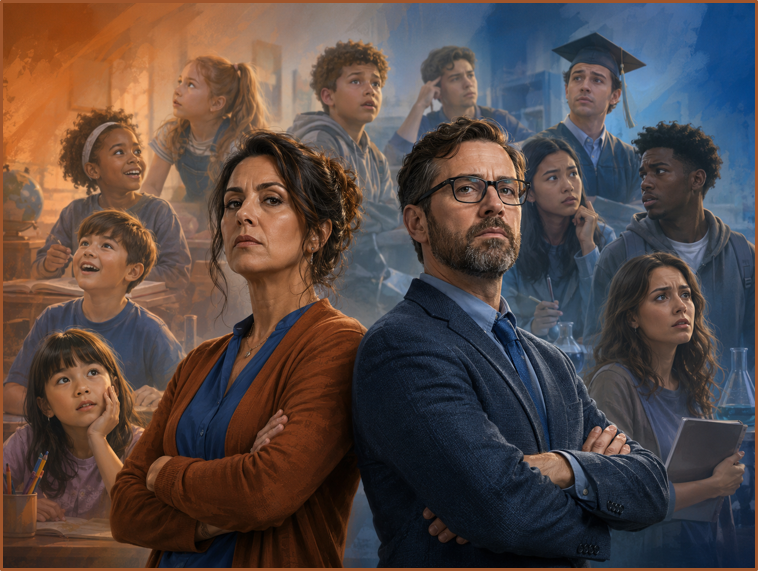
In the era of Artificial Intelligence, there are few things more tragic than closed-minded teachers, school principals, and administrators.
In a profession whose sacred purpose is to open the minds and thinking of students from kindergarten through college, to choose to remain closed-minded to the most powerful teaching intelligence in history borders on criminal.
That may sound harsh.
But we believe the moment requires harsh clarity.
Because this is not a small matter. This is not another curriculum debate. This is not a disagreement over textbooks, classroom technology, grading methods, or whether phones belong in backpacks or lockers.
Artificial Intelligence is not merely another tool entering the classroom.
It is a new force impacting human formation.
And the tragedy is not that some educators are cautious. Caution is wise. Discernment is necessary. Guardrails are essential.
- The tragedy is when caution becomes avoidance.
- The tragedy is when prudence becomes fear.
- The tragedy is when professional responsibility is replaced by institutional inertia.
- The tragedy is when the adults entrusted with opening young minds close their own.
The Sacred Calling of the Teacher
Teaching has never been merely the transfer of information.
At its best, teaching is the formation of human beings.
A great teacher does not simply deliver content. A great teacher awakens curiosity. A great teacher models discipline. A great teacher teaches students how to think, how to question, how to wonder, how to struggle, how to revise, how to discover, and how to become more fully human.
The best teachers do not create dependency. They create capacity.
They do not merely tell students what to know. They help students become the kind of people who can learn, discern, reason, create, and contribute.
That is why teaching is one of the most important human vocations. It is also why closed-mindedness among educators is so devastating.
- When a banker refuses to understand AI, money may be mis-allocated.
- When a lawyer refuses to understand AI, legal work may become inefficient.
- When a business executive refuses to understand AI, an organization may fall behind.
But when a teacher refuses to understand AI, students are malformed for the future they are already entering.
That is a different category of failure.
The New Intelligence Has Already Entered the Classroom
AI is not waiting outside the school doors asking permission to enter. It is already inside.
- Students are already using it.
- Parents are already encountering it.
- Employers are already reorganizing around it.
- Universities are already adjusting to it.
- The broader culture is already being reshaped by it.
The only question is whether schools will form students wisely inside this new reality — or pretend the reality has not arrived.
Too many schools are still responding to AI as if the central question is:
“How do we stop students from cheating?”
That question matters, but it is far too small.
The deeper and more important question is:
“How do we prepare students to think, learn, create, discern, and remain human in a world where intelligence itself has become programmable, scalable, and instantly accessible?”
That is not a technology question.
That is a formation question.
And formation is supposed to be the business of education.
AI Does Not Replace Teachers. It Reveals Them.
One of the great fears among educators is that AI will replace teachers.
That fear is understandable. But it is also incomplete.
AI will not replace great teachers. AI will expose weak teaching.
AI will not cause teachers to lose their jobs. Other teachers who learn how to collaborate with AI will.
The New Intelligence will:
- expose classrooms built primarily on information delivery.
- expose assignments designed for compliance rather than thought.
- expose assessment systems that reward memorization while neglecting wisdom.
- expose institutions that talk about critical thinking but do not actually teach students how to think.
AI is not the enemy of education. AI is a mirror.
And many schools do not like what they are beginning to see.
A teacher who defines teaching as content distribution has reason to fear AI.
A teacher who defines teaching as human formation has reason to engage AI.
Because AI can help a good teacher become more effective, more responsive, more creative, and more attentive to the needs of individual students.
But AI cannot:
- give a teacher courage.
- give a principal vision.
- give an administrator moral imagination.
Those things must come from the human beings responsible for leading education.
The Closed Mind Hides Behind Noble Language
Closed-mindedness rarely announces itself honestly.
It does not usually say, “I am afraid of learning something new.”
It does not say, “I feel threatened by this.”
It does not say, “I do not want to rethink my assumptions.”
Instead, it often hides behind noble language.
- “We are protecting students.”
- “We are preserving academic integrity.”
- “We are taking a cautious approach.”
- “We are waiting for more clarity.”
- “We do not want to move too fast.”
Each of those statements can be valid. But each can also become a sophisticated excuse for doing nothing.
- There is a profound difference between discernment and delay.
- Between wisdom and avoidance.
- Between protecting students and leaving them unprepared.
In the age of AI, doing nothing is not neutral.
Doing nothing is a decision.
And for educational leaders, it may become one of the most consequential decisions they ever make.
The Real Danger Is Not That Students Will Use AI
Many educators are worried that students will use AI to avoid thinking.
That is a legitimate concern. But there is an even greater danger:
Students may never be taught how to use AI to think more deeply. That is the opportunity too many closed-minded educators are missing.
AI can be used lazily. It can produce shortcuts, shallow answers, and intellectual dependency.
But so can textbooks. So can calculators. So can the internet. So can poorly designed lectures. So can worksheets. So can standardized tests.
The problem is not the existence of the tool.
The problem is the absence of formation.
A student can use AI to cheat.
But a student can also use AI to ask better questions, explore competing viewpoints, test assumptions, practice writing, strengthen reasoning, receive feedback, simulate debates, clarify confusion, and develop intellectual confidence.
The tool does not determine the formation.
The teacher does. Or at least, the teacher should.
The Great Betrayal of the Student
The most heartbreaking part of this moment is that students are hungry for guidance.
- Students know AI is powerful.
- They know it is changing the world.
- They know adults are anxious about it.
But many of them do not know how to think about it. They do not know how to use it responsibly. They do not know how to distinguish assistance from dependency. They do not know how to preserve their own agency in a world of machine-generated answers.
- They need adults.
- They need guides.
- They need formation.
- They need teachers who are willing to walk into the unknown with them.
When educators refuse to engage AI seriously, they are not simply opting out of technology.
They are abandoning students at the edge of a new world.
That is the tragedy.
Not that teachers have questions. They should.
Not that schools need guardrails. They do.
Not that administrators are cautious. They must be.
The tragedy is when the people called to lead students into wisdom choose instead to retreat into institutional comfort.
Closed Minds Cannot Open Minds
There is a painful irony at the heart of this issue.
A closed-minded teacher cannot open the minds of students.
- Not fully.
- Not honestly.
- Not in the way this moment requires.
Students can sense when adults are afraid. They can sense when institutions are pretending. They can sense when the rules are disconnected from reality. They can sense when the people in charge are managing appearances rather than preparing them for life.
And once students sense that, trust erodes.
- Education depends on trust.
- Formation depends on trust.
- Leadership depends on trust.
If students believe their schools are avoiding the future rather than helping them face it, then schools will become less relevant at precisely the moment they need to become more formative.
This is one of the great risks of the AI era.
Schools may not be replaced by AI. They may become irrelevant because they refused to become wise.
The Call to Courage
This article is not an attack on teachers.
Just the opposite. It is a call to teachers.
- A call to remember the nobility of the profession.
- A call to recover intellectual courage.
- A call to stop treating AI as merely a cheating machine, a policy headache, an administrative burden, or just one more thing to learn.
This article and the work of FACTORS Digital Intelligence overall is a call to see AI for what it truly is:
- A civilizational shift in intelligence.
- A formation challenge.
- A moral responsibility.
- A teaching opportunity.
It is also a powerful driver for elevating their own capabilities and intelligence, while they are helping to form their students.
The educators who rise to this moment will become some of the most important leaders of the next generation.
They will help students learn how to think with AI without surrendering their own minds to it.
They will teach students how to question machine outputs, test ideas, pursue truth, preserve dignity, and use intelligence in service of wisdom.
They will help form students who are not merely employable, but discerning.
Not merely efficient, but thoughtful.
Not merely informed, but wise.
That is the future that education should be building.
The Teachers We Need Now
We do not need:
- Teachers who worship AI.
- Teachers who blindly adopt every new tool.
- Teachers who confuse innovation with wisdom.
We need something and our children deserve much better.
- We need teachers with open minds and grounded souls.
- We need principals who understand that formation must come before technology.
- We need administrators who recognize that policy is not enough.
- We need schools that teach students not merely how to use AI, but how to remain human while using it.
- We need educators who are humble enough to learn, courageous enough to lead, and wise enough to discern.
The future does not belong to AI.
The future belongs to the humans who learn how to govern it, guide it, question it, and use it for human flourishing.
That work begins in schools.
And it begins with teachers.
Formation Unfulfilled
The tragedy of closed-minded teachers is not that they fail to understand technology.
It is that they fail to fulfill formation.
They stand at one of the most important thresholds in educational history, holding the responsibility to guide young people into a world transformed by Artificial Intelligence.
And some are choosing to look away. That choice cannot be softened forever.
It cannot be hidden behind committee meetings, policy reviews, or cautious language.
At some point, every educator, principal, and administrator will have to answer a simple question:
When the most powerful teaching intelligence in history arrived, did you help students become wiser humans?
Or did you close your mind and call it responsibility?
That is the all-too-common tragedy currently running across education. And it is not too late to prevent it.
About the Author
Rich Hoffmann is a founder, architect, entrepreneur, and lifelong learner whose work in Digital Intelligence has been shaped by a deeply personal realization: the kind of intellectual formation now becoming possible through AI was not available to him during his formative years.
Like many students of his generation, Rich experienced an education system that too often emphasized information, compliance, and performance over curiosity, reasoning, discernment, and the deeper formation of the human mind. He did not have teachers who consistently taught students how to think, how to question, how to discover their own intellectual capacity, or how to develop the habits of wisdom.
As a result, much of what good teachers have always had the power to cultivate in young people took Rich an entire lifetime to acquire through experience, struggle, entrepreneurship, failure, faith, reflection, and relentless self-education.
That personal journey now informs his work as Founder–Architect of FACTORS Digital Intelligence, where he and FACTORS co-founder and CEO, Robin Stewart, are building AI 2.0 systems designed not merely to produce answers, but to help form wiser humans. Rich, Robin, and their mission-driven team believe that the arrival of Artificial Intelligence creates a once-in-history opportunity for teachers, parents, schools, and institutions to recover the true purpose of education: the formation of human beings who can think clearly, discern wisely, create courageously, and live meaningfully.
This article was written from that conviction — and from the FACTORS hope that future generations will not have to spend a lifetime recovering what formation-centered education could have given them from the beginning.