Music as a Vehicle for Transformation
For most of my life, I didn’t really understand Pink Floyd.
That’s not easy to admit for someone who grew up during one of the greatest eras in popular music. I had no trouble connecting with The Beatles, The Rolling Stones, The Beach Boys, Eric Clapton-led bands, The Carpenters, The Doors, Led Zeppelin, Jimi Hendrix, Bob Dylan, and many others.
They gave me familiar handles.
Melody. Rebellion. Harmony. Blues power. Romance. Protest. Poetry. Virtuosity. Emotional immediacy.
But Pink Floyd?
For decades, I mostly left them on the shelf.
I knew they mattered. I knew serious music people treated them as one of the great bands. I knew the albums, the imagery, the cultural weight.
But I didn’t really enter their world.
And that, I now realize, was the point.
I was trying to listen to Pink Floyd as if they were simply another band writing songs.
They weren’t.
They were building experiences.
Why Pink Floyd Makes Sense to Me Now
Over the last few months, I have found myself unexpectedly drawn to Pink Floyd.
The question in the back of my mind was simple:
Why now?
Why Pink Floyd? Why after all these years?
At first, I thought maybe age had changed my ear. That’s probably true. Life gives you access to rooms in music that youth often walks past.
But the deeper reason is this:
I am not listening to Pink Floyd now merely as a music fan.
I am listening as a founder-architect building FACTORS Digital Intelligence.
And once that clicked, Pink Floyd suddenly made much more sense.
Pink Floyd Changed the Unit of Meaning
Most popular music gives listeners something they can grab quickly: a chorus, a riff, a lyric, a groove, a voice, a feeling.
Pink Floyd often worked differently.
They were not simply asking, “Do you like this song?”
They were asking:
Can you enter this experience?
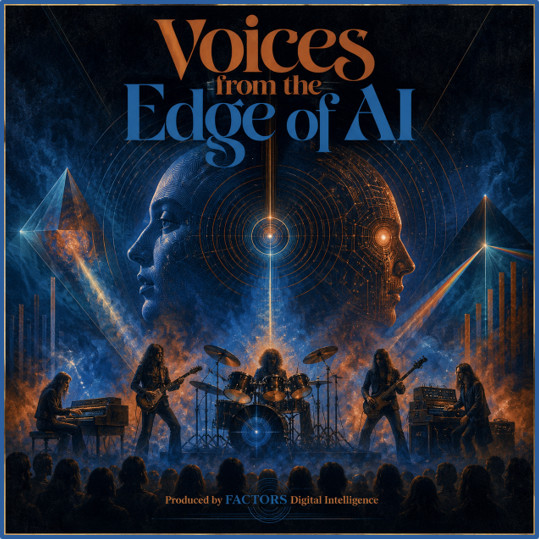
Their music created atmospheres, psychological rooms, emotional landscapes, and symbolic worlds. The meaning did not always sit inside one song. It emerged from the whole architecture — the sequencing, sound, silence, tension, repetition, unease, and cumulative emotional effect.
That is the phrase that unlocked it for me:
Pink Floyd changed the unit of meaning in rock music from the song to the experience.
And that is exactly where the connection to Artificial Intelligence and to our work in Digital Intelligence begins.
Most AI Companies Are Building Singles
Most AI companies today are building the equivalent of catchy singles:
- Faster tools.
- Sharper answers.
- Better automation.
- Clever chatbots.
- Productivity gains.
- Impressive demos.
And many of those tools are useful. Some are remarkable.
But tools are not enough.
Because AI is not merely something humans will use.
AI is something humans will increasingly develop inside of.
That changes the design challenge completely.
If AI is only a tool, then speed, power, convenience, and efficiency become the main goals.
But if AI is an environment that shapes how humans think, learn, choose, relate, and become, then architecture matters:
- The atmosphere matters.
- The guardrails matter.
- The moral framework matters.
- The experience matters.
- The formation matters.
In other words:
As with Pink Floyd, the environment is the message — and the experience is the formation.
The intelligence environment is the formation system. The architecture is the pedagogy. The experience is the resulting formation.
That is the Pink Floyd lesson applied to AI … and to all of us.
FACTORS Built the Concept Album
FACTORS Digital Intelligence was never trying to build another AI single.
Somehow, we always knew from the beginning two and a half years ago that we’ve been building the concept album.
Not in the musical sense, of course. In the architectural sense.
A concept album asks the listener to enter a larger frame. Its meaning comes from relationship, sequence, recurrence, contrast, mood, and cumulative impact.
FACTORS works the same way.
Its value is not found only in one feature, chatbot, assessment, agent, module, or interface.
The value emerges from the whole intelligence environment:
- Digital Intelligence
- Ethical Intelligence
- Human formation
- Reflection
- Measurement
- Identity
- Wisdom
- Responsible action
All designed to develop together.
That is why FACTORS may be hard for some people to understand at first. They may be trying to hear a song when we are building a world of The New Intelligence.
They may be looking for a tool when we are building a formative intelligence environment.
They may be asking, “What does AI do?” before they are ready to ask, “What does AI form?”
AI 1.0 Asked the Wrong First Question
AI 1.0 has mostly asked:
What can AI do?
- Can it answer questions?
- Can it automate tasks?
- Can it summarize documents?
- Can it write code?
- Can it generate content?
- Can it increase productivity?
Those are useful questions. But they are not enough.
FACTORS begins with a deeper, Pink Floyd-style question:
What kind of human does this intelligence environment help form?
That question changes everything.
Because AI will not merely sit outside us as a tool we occasionally pick up and put down. It will increasingly surround our thinking, influence our decisions, shape our attention, guide our learning, mediate our relationships, and affect our sense of what is true, good, possible, and human.
That is not just a technology problem. That is a formation problem.
And formation problems require more than features. They require architecture.
That is why FACTORS brings Digital Intelligence together with Ethical Intelligence. That is why the Veritas Ethical Operating System matters. That is why Collaborative Resonance and AIR matter.
The goal is not just smarter machines.
The goal is wiser humans.
Maybe I Didn’t Miss Pink Floyd
The Beatles helped me discover Collaborative Resonance. Pink Floyd helped me hear the architecture.
So maybe I didn’t simply miss Pink Floyd as a teenager.
Maybe I arrived when I was ready to understand what they were doing.
- Earlier in life, I wanted the song. Now I can hear the architecture.
- Earlier in life, I wanted the hook. Now I can enter the atmosphere.
- Earlier in life, I listened for whether I liked it. Now I listen for what it forms.
That shift is not only musical.
It is connected to the work we are doing now.
We are entering an era in which Artificial Intelligence will not merely answer human questions. It will shape the humans asking them.
Pink Floyd taught me that some creative breakthroughs are not immediately understood because people are looking for the wrong unit of meaning.
They are listening for the song when the artist is building an experience.
In the same way, many people are still looking for AI tools when the real question is what kind of intelligence environment we are building around human beings.
That is the work of FACTORS Digital Intelligence.
Not merely to build smarter machines.
But to create the architectures through which wiser humans can emerge.
Building Smarter Machines for Wiser Humans ™
Join us in the studio. Be a FACTOR.
About the Author
Rich Hoffmann is the Founder-Architect of FACTORS Digital Intelligence, a platform company building governed intelligence environments for the age of AI 2.0. After decades in technology, entrepreneurship, and product strategy, Rich is now focused on one central mission: helping ensure that smarter machines lead to wiser humans.
Through FACTORS Digital Intelligence, the Veritas Ethical Operating System, Collaborative Resonance, and AIR — AI-Ignited Resonance — Rich and his team are developing a new architecture for human-centered AI: one that treats artificial intelligence not merely as a tool, but as a formative environment capable of shaping how people think, learn, decide, create, and become.
He is also a lifelong music lover who apparently needed only fifty years, a few concept albums, and a founder-architect’s ear to finally understand what Pink Floyd was doing all along.