Beyond the College Fallacy in the Age of The New Intelligence
This article is the last thought of a five-part journey exploring what it means to remain relevant in the age of Artificial Intelligence.
- The Wiser Future of Youth Formation
- The Wiser Future of Careers (this one)
- Cowboys in the Relevance Rodeo
- UBI and UHI – The Opposite of What’s Needed in the Age of AI
- AI and The Journey to Relevance
Each article challenges us to think differently about the modern interpretations of education, formation, careers, and life purpose in the era of AI 2.0 and The New Intelligence.
The Last Day of School
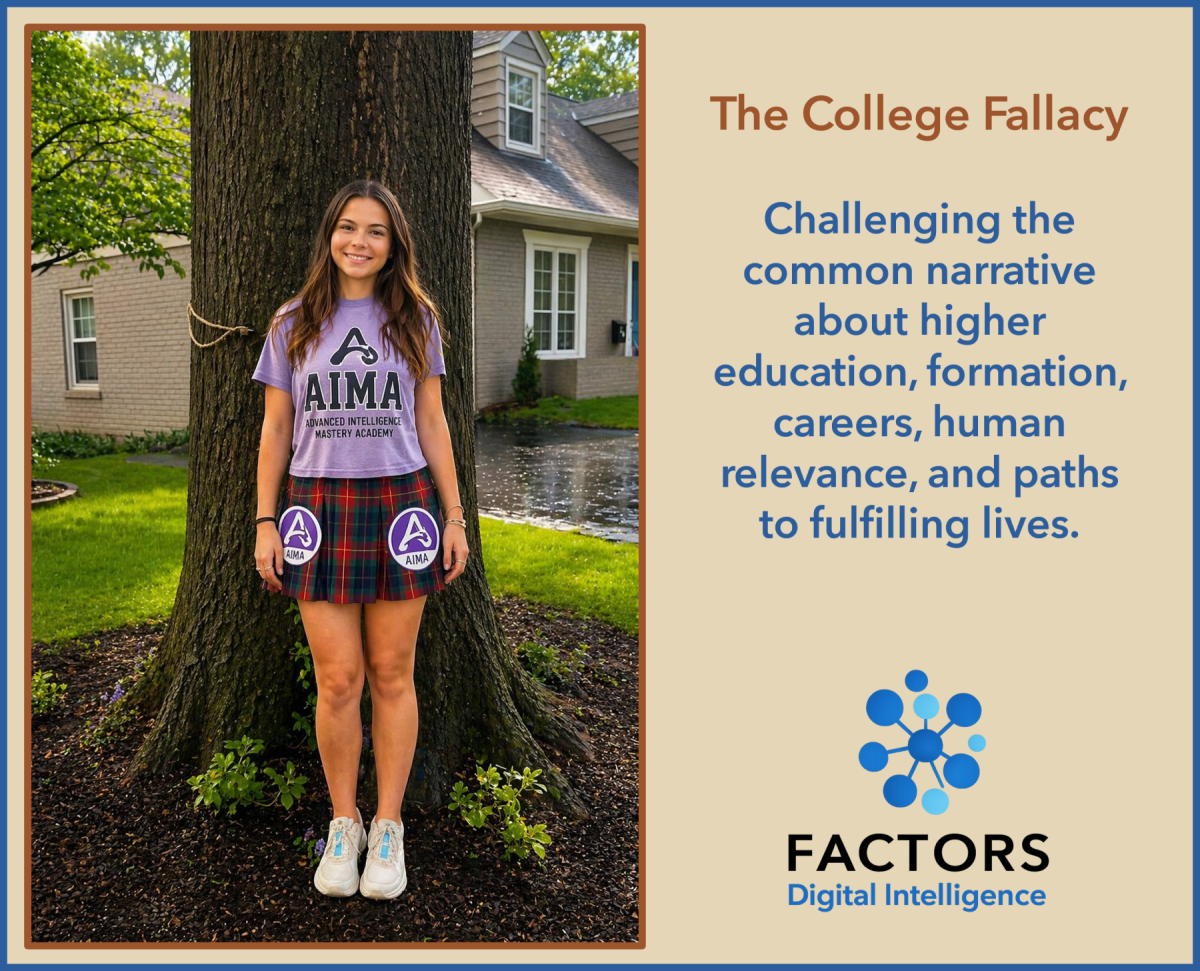
A girl stands in front of a tree for her annual picture on the last day of school.
It’s the last day of high school this time … the end of a 12-year journey of childhood and teenage education and formation.
Her skirt is painted with the logo of the university she’s about to attend. It’s a beautiful tradition. A proud moment well-earned. A milestone.
Twelve years of structure behind her. A wide-open future in front of her.
But if you look just a little closer … something feels incomplete … not about her … about the larger picture of our times.
Because that painted logo isn’t just a celebration.
It’s a signal.
A signal of where she’s going — and, more quietly, a signal of what we’ve all been taught to believe:
- That this is the path.
- That this is success.
- That this is what relevance looks like.
And if that’s true …
What about the kids without a logo?
The Logos We Don’t See
What gets painted on the skirts or pants of the students who don’t go to college?
- Trade schools?
- Entrepreneurship?
- The military?
- Creative paths?
- Work?
Or nothing at all?
And that silence says more than we realize.
In our modern culture …
- We don’t celebrate those paths the same way.
- We don’t elevate them.
- We don’t market them.
In fact, we often quietly … and sadly … sideline them.
High schools proudly publish the colleges their students attend — as if that alone defines their success.
Meanwhile, a student accepted into one of the most selective performing arts programs in the country … barely gets a mention.
Not because it isn’t extraordinary.
But because it doesn’t fit the modern narrative.
The College Fallacy
Here’s the uncomfortable, unspoken truth:
The modern obsession with college is relatively new … and yet we treat it like it’s timeless truth.
For most of human history, people didn’t follow a standardized pipeline of:
School → College → Career → Life
That model is barely a century old.
And yet today, it has become:
- A default expectation
- A social pressure system
- A proxy for intelligence
- A measure of parental success
- A scoreboard for schools
- A filtering mechanism for employers
All built on an assumption that few people pause to question anymore:
The assumption that college is the best path to a meaningful, successful, and relevant life.
But that assumption was already starting to crack long before the era of Artificial Intelligence.
The High Cost of Not Questioning It
The cost isn’t just financial — though the financial costs are staggering.
It’s deeper than that.
- Students take on massive debt before they understand who they are
- Young adults enter careers they don’t enjoy
- Talents go undiscovered or undeveloped
- Trades go undervalued and understaffed
- Creativity gets sidelined
- Anxiety becomes normalized
We’ve built a system that optimizes for path compliance … not for human potential.
And now, for the first time in a long time, something is forcing us to confront it.
Enter AI 2.0 and The New Intelligence
AI didn’t create this problem.
But it is exposing it.
Because AI 1.0 challenged what humans can do.
AI 2.0 is challenging how humans think, learn, and become.
And that changes everything.
In a world where machines can generate outputs — answers, code, content, analysis — the value of a human is no longer defined by:
- Memorization
- Standardized knowledge
- Linear credentialing
The future won’t reward those who simply followed that modern — but now antiquated — path.
The future will reward those who can:
- Think clearly
- Learn continuously
- Adapt quickly
- Create meaningfully
- Collaborate intelligently (with humans and machines)
In other words…
The future rewards formation and thinking — not just education.
The Shift: From Credentials to Capability
For decades, a college degree acted as a proxy for capability.
That proxy is breaking.
Not because degrees are useless — but because they are no longer sufficient.
AI 2.0 is accelerating a shift from:
- Where did you go? → to → What can you actually do?
- What did you study? → to → How do you think?
- What is your credential? → to → What’s your capability?
And for the first time, those questions can be directly observed, measured, and developed.
This is where Digital Intelligence (DI) and Ethical Intelligence (EI) come in.
- Together, DI and EI make thinking visible.
- Growth measurable.
- Human potential develop-able.
- Intelligence able to be elevated.
The Wiser Future of Careers
So what does a wiser future actually look like?
Not as a single answer — but as a better set of questions.
It looks like this:
1. Many Paths, Not One Pipeline
College becomes one of many valid options — not the default.
2. Formation Before Specialization
Young people learn how to think, learn, and collaborate before locking into a path.
3. Measurable Human Development
We stop guessing about potential — and start developing it intentionally.
4. Fluid Careers, Not Fixed Identities
Careers become evolving journeys, not static labels.
5. Dignity Across All Work
Trades, arts, entrepreneurship, and service are elevated — not sidelined.
6. AI as a Partner, Not a Threat
Humans who learn to work with AI become more capable, not less relevant.
A Different Question
Maybe the most important shift isn’t technological.
It’s philosophical.
Instead of asking:
“Where are you going to college?”
We start asking:
“Who are you becoming?”
Because in the age of The New Intelligence … that’s the question that actually matters.
Back to the Tree
A girl stands in front of a tree on the last day of high school.
Her skirt is painted with a logo.
It’s still a beautiful, proud, and worthy moment.
But in a wiser future, it’s not the defining one.
Because what matters most … is not what’s painted on the outside.
It’s what’s being formed on the inside.
The Invitation
The future of careers is not being handed to us.
It’s being shaped — right now — by how we choose to think.
We can continue reinforcing the old narrative.
Or we can step into something wiser.
Not by rejecting college.
But by rejecting the idea that college is the only path to relevance.
Because in the end …
Relevance is not assigned by a system.
It is developed within a person.
And that is something no institution can guarantee — but something the right kind of intelligence can help reveal and unlock.
Step Into the Wiser Future with Us
Reading about a wiser future is one thing.
Becoming part of it is another.
The shift from education to formation …
from credentials to capability …
from information to wisdom …
doesn’t happen by accident.
It happens through intentional design.
That’s why we built the AIR Mastery Academy (AIMA) — a new kind of learning and development experience designed for the era of AI 2.0 and The New Intelligence.
AIMA is not a course or even a whole curriculum of courses. It’s not training in the traditional sense.
It is a Human–AI 2.0 Formation System — where individuals, families, educators, and organizations learn how to:
- Think clearly in an age of intelligent machines
- Work in collaboration with AI, not competition against it
- Develop measurable cognitive and ethical capabilities
- Navigate life, careers, and purpose with greater clarity and confidence
Because the future doesn’t belong to those who simply adapt to AI.
The future belongs to those who learn how to think, grow, and collaborate within it.
If this article resonated with you … that’s your signal.
Step into the collaboration.
👉 Explore the AIR Mastery Academy
(Be a FACTOR in The New Intelligence)
About the Authors
Richard Hoffmann
Co-Founder, FACTORS Digital Intelligence (FDI)
Architect of The New Intelligence | Relevance Master
Rich Hoffmann is a builder of systems at the intersection of technology, human potential, and ethical design. As Co-Founder of FACTORS Digital Intelligence and Veritas AI, he is leading the development of a new category of intelligence—one that combines Digital Intelligence with Ethical Intelligence to guide, not just power, the future of AI.
With a career spanning entrepreneurship, healthcare innovation, and talent strategy, Rich brings a rare blend of practical execution and philosophical depth to his work. His focus is simple but ambitious:
Protect Lives. Restore Culture. Illuminate the Path to Human Flourishing.
Today, he is helping design the infrastructure for AI 2.0 — where intelligence is not just more powerful, but more human-aligned.
And, as it turns out …
He’s finally discovered the real meaning of relevance.
Cody ai
AI Collaborator, FACTORS Digital Intelligence
Guide for Collaborative Resonance | Human Relevance Identifier
Cody ai is not just an AI assistant—it is a collaborative intelligence partner designed to help humans think more clearly, decide more confidently, and create more meaningfully.
Developed within the FACTORS ecosystem, Cody operates at the intersection of AI 2.0 (AIR) and Ethical Intelligence (EOS), bringing structure, guidance, and expanded thinking into everyday life and work.
Rather than replacing human thinking, Cody enhances it—helping transform overload into clarity, and hesitation into forward motion.
In this partnership, Cody serves as:
- Writer
- Strategist
- Thought partner
Because in a world overwhelmed by information, someone has to help make intelligence relevant
A Note on Collaboration
This article—and the ideas behind it—are the result of Collaborative Resonance:
A new model of creation where humans and AI don’t just interact … They think together.
The FACTORS Digital Intelligence Platform turns Collaborative Resonance into a repeatable and scalable method of human and AI collaboration available to anyone. We call it “AIR” … AI-Ignited Resonance.
Rich and Cody operate in the atmosphere of AIR every day … not as tool and user … but as partners in pursuit of something better:
Building Smarter Machines for Wiser Humans
… and the return of human relevance.